How much population growth is too much for Switzerland?
A clear summary of the "10-Million Switzerland" initiative being voted on nationally on June 14, 2026. Here is what expats should know.
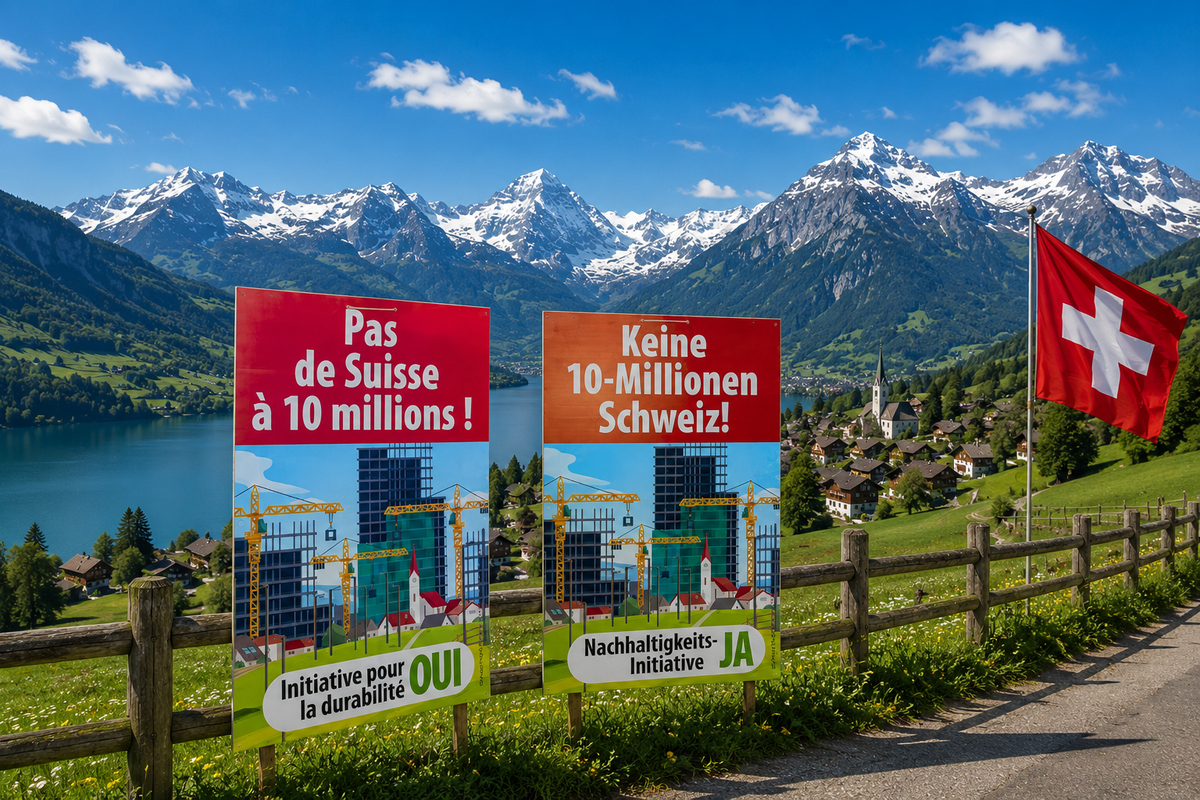
Chances are that you have seen and heard about the "Keine 10-Millionen-Schweiz" initiative plastered across Switzerland and discussed during coffee breaks. It is also being called the "Nachhaltigkeitsinitiative" (Sustainability Initiative) by its promoters. Big letters and catchy slogans combined with images of bursting local infrastructure, like overcrowded trains during the morning commute.
The campaign creates a feeling that someone is clearly upset about something. And expats would not be entirely wrong to think: Oh, is this about me? Let's have a closer look at what the Swiss are voting about on June 14th, 2026, and we will also check into the numbers behind all the claims.
In a nutshell
What's most important for you to know:
- The SVP political party is pushing for a constitutional rule that would cap Switzerland's population at 10 million people before 2050 – a hard ceiling to be written into the constitution itself.
- Actual implementation steps are less clear. The new requirement could force Switzerland to walk away from the Free Movement of Persons agreement with the EU, which would likely pull it out of the rest of the bilateral agreements it has with the EU.
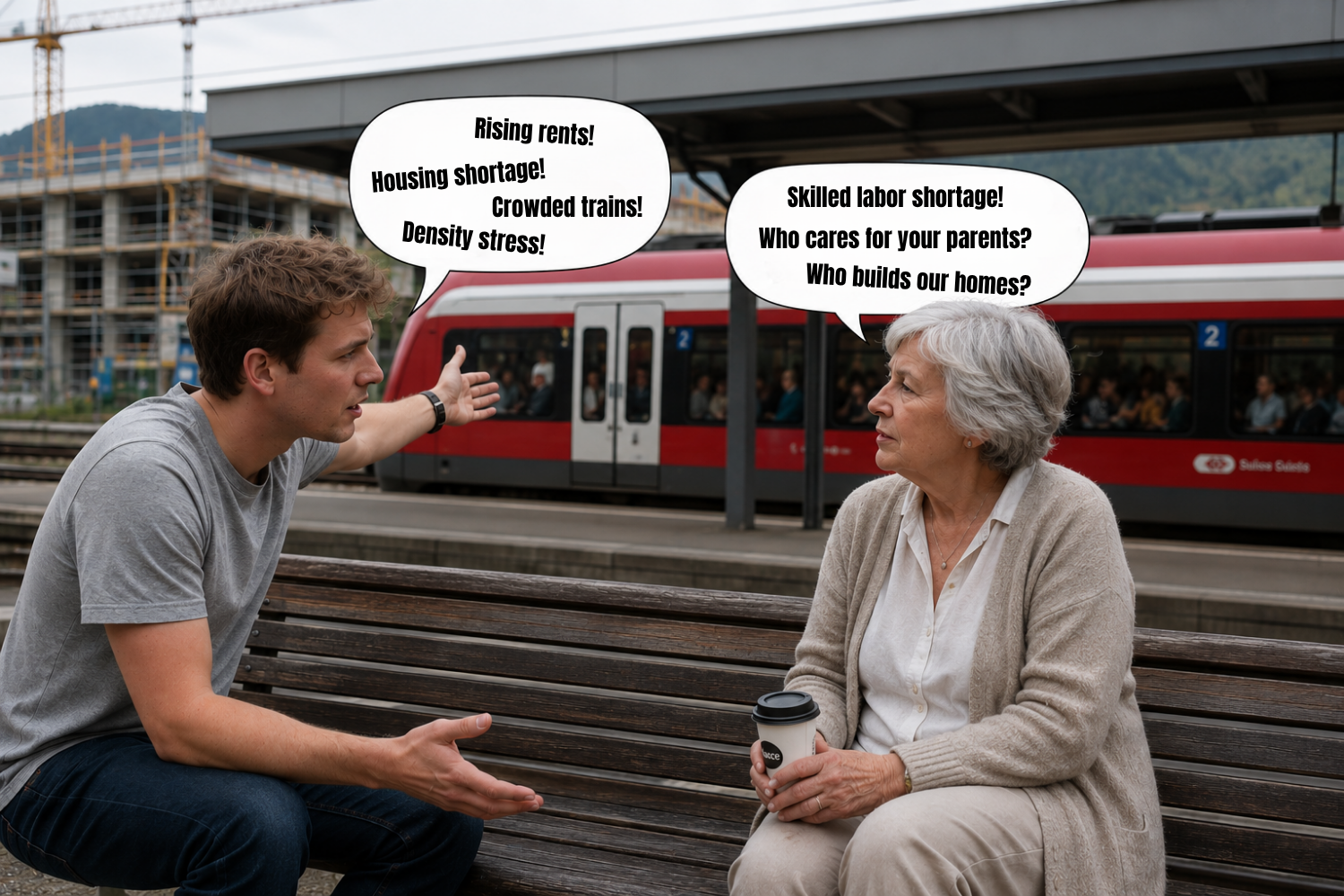
- Supporters of the cap point to packed trains, sky-high rents, urban sprawl, and stretched infrastructure as proof that population growth has gone too far.
- Opponents have nicknamed it the "Chaos Initiative" and argue it would shred the labour market, divide families, and end Switzerland's relationship with Europe in one go.
➡️ The supporters: Campaign site of SVP (in German/French/Italian)
➡️ The opponents: Gewerkschaft UNIA (in German)
If you're an expat, you've probably noticed by now that immigration is a topic Swiss people discuss with a particular emotional charge. This latest vote concentrates all of that into a single ballot question. So let's dive into the overview: what's actually being voted on, what the relevant data says, what people are worried about, and what it means for the international community living here.
Immigration as an evergreen topic
It's worth saying upfront: this debate is not at all new. The question of how much immigration is healthy for Switzerland has been part of the political conversation for decades, e.g.:
- The Schwarzenbach initiatives of the 1970s (in German/French)
- The European Economic Area vote in 1992
- The mass immigration initiative in 2014
Switzerland is a small country with limited space, and that physical reality shapes the debate. At the same time, immigration is argued by many as one of the engines of Swiss prosperity: doctors and nursing staff in hospitals, construction workers for new homes, tunnel builders for the Gotthard train route, and researchers in the pharma industry. Foreigners have helped the Swiss economy remain one of the most productive in the world. Both these things are true at once, and that's why the conversation never really ends.
What the SVP's initiative proposes
The initiative would write a hard population ceiling into the Swiss Federal Constitution: no more than 10 million permanent residents before 2050, with an exception for natural births. Once the population hits 9.5 million, the government would be required to act by targeting foreign migration to Switzerland for asylum and family reunification reasons first.
If those initial measures do not work and the population still crosses 10 million for two consecutive years, Switzerland would be obligated to terminate the existing Free Movement of Persons agreement (FZA) with the EU to limit the migration of EU nationals to Switzerland.
Legally, that single move would automatically trigger the so-called guillotine clause and pull down the entire first package of bilateral agreements Switzerland has with the EU (Bilaterale I). That agreement covers lots of topics, from allowing free trade to cross-border transport of inter-city trains. The second package, known as Bilaterale II, would not be affected as directly.
You can learn more about the details in the proposal as summarized by SRF and the Federal Council.
A look at the numbers
This is where things get interesting, because the public debate often skips past the math. At the end of 2025, Switzerland's permanent resident population was roughly 9.1 million people.
Net migration has been going down
For over a decade, net migration into Switzerland kept climbing. Then, in 2024, it started falling and kept falling in 2025. The trend that fuelled this debate is, for now, reversing:
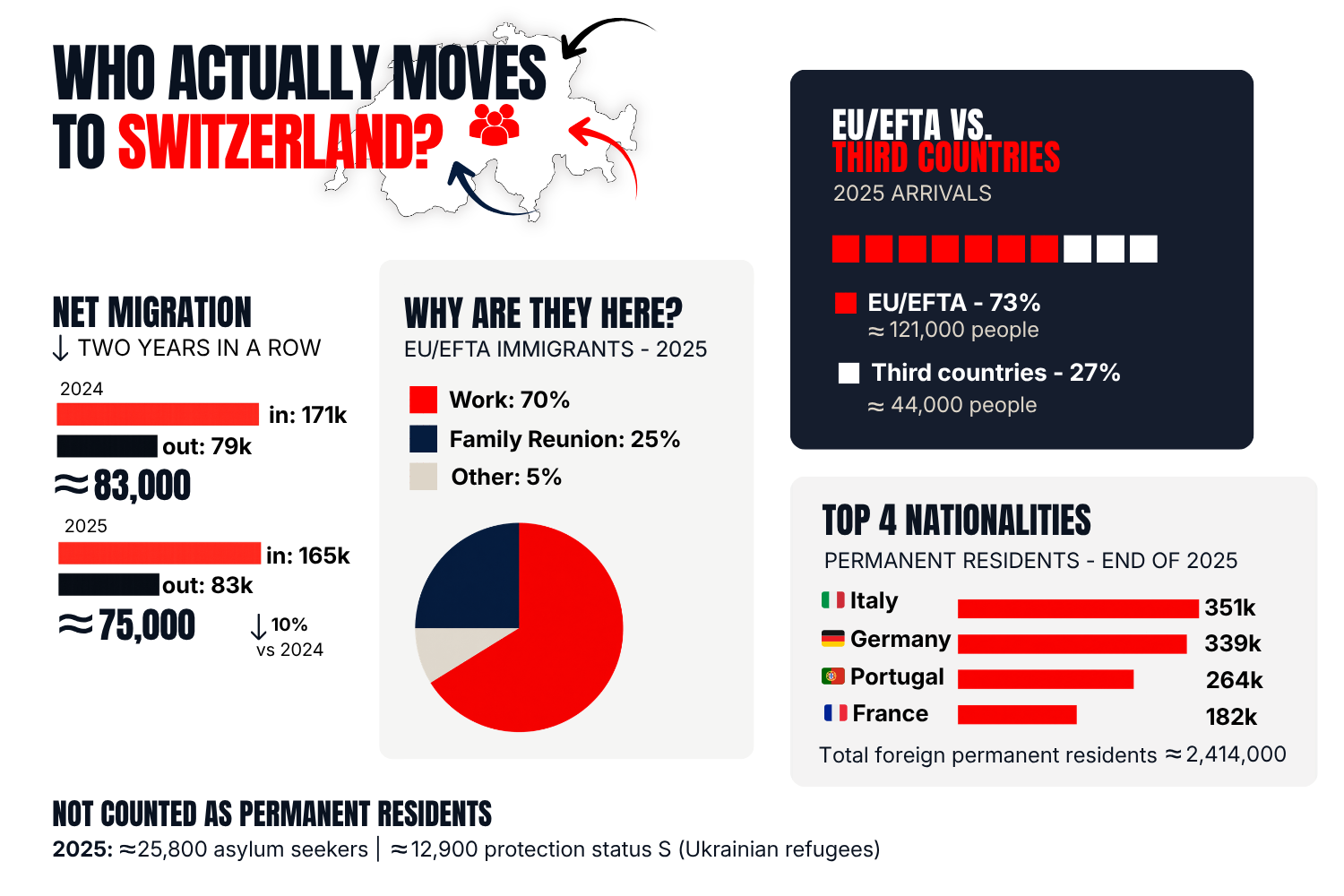
- 2025: ~165,000 people immigrated into the permanent foreign resident population, and ~83,000 left. Net migration: ~75,000 people – about 10% lower than 2024.
- 2024: ~171,000 immigrated, and ~79,000 left. Net migration: ~83,000 people – about 16% lower than 2023.
Important to note is that "permanent residents" here means anyone living in Switzerland for 12+ months with a valid residence permit. Both asylum seekers and Ukrainian citizens given temporary residency (under the special protection Status S) are not included. Although critics argue that these people are also Swiss residents and contribute to the overburdening of local infrastructure such as trains, roads, and hospitals.
Under the SVP initiative's proposal, asylum and family reunification are the first categories the government must target once the population hits 9.5 million – though legal experts note that international law significantly limits how far those levers can actually be pulled.
Where do immigrants in Switzerland come from?
In 2025, roughly 165,000 people moved to Switzerland from abroad. Of these:
- ~80% came from EU/EFTA countries (around 132,000 people)
- ~20% came from third countries (around 33,000 people)
The four largest groups of foreign nationals living permanently in Switzerland at the end of 2025: Italians (~351,000), Germans (~339,000), Portuguese (~264,000), and French (~182,000). You might be wondering: why are Italians #1? Immigration from Italy largely leads because of a long history: Italians have been Switzerland's largest foreign community since the 1950's "Gastarbeiter" (guest worker) era. This was long before a free movement agreement with the EU existed (Switzerland only joined the Schengen Zone in 2004). Italian workers used to work and live seasonally in Switzerland, largely supporting the construction of new buildings and infrastructure. Over time, they settled and brought their families with them.
What brings immigrants to Switzerland?
Around 70% of EU/EFTA immigration is driven by employment. The employment rate among this group is over 85% – meaning the majority have gainful employment. Of those who immigrated for long-term work in 2025: 80% are in the service sector, 18% in industry/construction/trades, and 2% in agriculture. Family reunification accounted for around 25% of long-term immigration of EU/EFTA nationals.
SEM's official 2025 migration report
SEM's annual migration statistics for 2024
SRF's reporting on the recently decreasing net migration
What makes Switzerland popular?
If you're going to debate the symptoms, it helps to understand the cause. Switzerland is desirable to many foreign immigrants for some specific, practical reasons:
- Strong, stable economy with low unemployment (consistently among the lowest in Europe), and an attractive, internationally oriented job market. Zurich in particular has become one of Europe's leading tech hubs, and Zug has become one of Europe's most concentrated fintech and crypto hubs.
- High wages – the Swiss median salary is among the highest in the world, even adjusted for cost of living.
- Geographic and lifestyle appeal – Stunning landscapes, safe neighborhoods, and a quality of life that consistently ranks among the best in the world.
- World-class research and education – ETH Zurich consistently ranks among the top 10 universities globally, alongside EPFL in Lausanne. This creates a pipeline of international talent that feeds directly into the specialized industries based nearby.
- Politically stable – Switzerland's political system is built on direct democracy. Citizens can challenge any law by referendum, and major decisions go directly to a popular vote. This has led to fewer swings in regulatory policies and greater stability in subsidy and tax laws that businesses can rely on for the longer term.
- Comparatively low corporate and individual taxes, especially in cantons like Zug, Schwyz, and Nidwalden. Many companies (and individuals) chose Switzerland for its minimal bureaucracy and low cost of doing business.
- High quality of public services: Healthcare, education, and public transport are often rated highly.
- Important international institutions are based in Switzerland, such as many United Nations agencies in Geneva. These pull in international talent along with the external stakeholders who collaborate with them.
Debating the SVP proposal: who's saying what?
✅ Pro (supporters of a YES vote)
SVP and supporting committees argue:
- Switzerland's population growth has reached a tipping point. Infrastructure, housing, and nature can't keep up.
- The Federal Council has had decades to manage migration, and they did not manage to do it – direct constitutional limits are the only realistic tool left.
- A binding cap forces real action to address housing pressure, growing commuter traffic, and overstretched public services.
- Sovereignty: Switzerland should decide its own population trajectory, not the EU government leadership in Brussels.
- Asylum and family reunification are the first two immigrant groups that should be limited. This is the most feasible approach without needing to change the agreements with the EU on the free movement of persons.
Notable supporters beyond the SVP itself include parts of Die Mitte party's base, some influential Swiss company CEOs, and some FDP party voters (who are actually at odds with their own party's leadership on this topic). Former SP (left wing) party National Council member Rudolf Strahm has even called the initiative imperfect but said it "addresses a serious problem."
❌ Contra (supporters of a NO vote)
The Swiss Federal Council, the national Parliament majority, various business associations, and many other political parties argue:
- A constitutional cap is a blunt instrument that cannot be applied flexibly enough.
- The skill shortage is acute, and immigrants are needed to meet market needs. This is particularly the case in elderly care, healthcare, construction, and skilled trades. The proposal would make this shortage worse, not better.
- This would terminate the free movement agreement with the EU and would therefore dissolve the "Bilaterale I" agreement package. This would be a major hit to exports, research collaboration, and transport.
- The Federal Council estimates additional annual costs in the billions as fallout from the population cap.
- Population growth has multiple causes (longer life expectancy, internal mobility), so such a single cap does not solve the underlying pressures.
- It would fundamentally change Switzerland's economic model overnight with unclear gains.
The opposing coalition is unusually broad: SP, Greens, GLP, Mitte, FDP, Economiesuisse, GastroSuisse, Operation Libero, Swiss Trade Union Federation, and the Swiss Tenants' Association. Some of these are often political opponents who rarely agree on anything else.
Overview of polling aggregated by Watson
NZZ's summary of the initiative
20 Minute's article on campaign budgets
SVP's official pro campaign page
UNIA's official contra campaign page
Some open questions worth thinking about
This is arguably a vote with no easy "right" answer. A few questions worth considering while you form your own opinion:
- What level of population growth is healthy for a country like Switzerland? Is there a number? And who decides?
- If immigration were sharply restricted, who would do the jobs Swiss citizens currently don't fill – particularly in elderly care, medicine, hospitality, construction, and agriculture?
- Are housing pressure and crowded trains primarily a migration problem, or rather a policy problem? Some analysts argue that other existing construction caps, strict zoning laws, and infrastructure investment choices are important domestic levers increasing these pressures (and that it's not due to immigration).
- What are the trade-offs of leaving the bilateral agreement framework with the EU? Many Swiss exporters say the costs would be "substantial", but how substantial really?
Our take
We've done the research and written this article to be informative and balanced. The SVP initiative deserves some careful deliberation. Our goal is to help expats thrive in Switzerland, and we also want to be honest about where we personally stand (and we welcome hearing your thoughts, too!).
Looking at the numbers, it seems clear to us that most of the international community is here because Switzerland needs them. The Swiss healthcare system, the construction sites, the gastronomy sector, the research and innovation labs in tech and pharma companies: foreign workers built and run a meaningful share of the Swiss economy and local services. Telling that group "you're the problem" while simultaneously relying on them to keep things running is a contradiction that the initiative does not resolve.
That said, we recognize that the underlying frustrations — limited available housing, crowded infrastructure, the feeling that things are getting tighter — are not invented. We hear them from our Swiss-born neighbours and foreign expat friends alike. Those problems need to be addressed, but we're just not convinced when looking at the evidence that a constitutional population ceiling is the best approach.
If you can vote: inform yourself, talk to people on both sides, and go vote! If you can't vote, you can still have an informed opinion. Ask your colleagues what they think, listen to the arguments, and challenge your own (and others') perspective. This is the kind of vote that will quietly shape how Switzerland feels as a place to live in the years to come.
Wrap Up
Now you know:
- The vote on June 14, 2026, is on the SVP's "Keine 10-Millionen-Schweiz / Nachhaltigkeitsinitiative". Opponents call it the "Chaos-Initiative."
- The SVP's proposal would cap Switzerland's permanent resident population at 10 million before 2050 and could trigger termination of many existing agreements with the EU.
- Net migration has recently been decreasing – down to ~75,000 in 2025.
- The immigrant community in Switzerland is overwhelmingly here for work under structured legal conditions.
- The vote is closer than usual: polls hover around 45–52% YES (early May 2026), with sharp regional and party-based differences.
- It's worth forming your own view, and if you can vote, please do.
🫵 What do you think about the initiative?
Subscribe and share your views by adding a comment below! 👇
Want more helpful insights like this?
Click the subscribe button in the bottom right of this window to get to our free newsletter! We share curated information and tips to build a better life in Switzerland.


Comments ()