
Swiss politics explained for expats
How the Federal Council works and how direct democracy lets the Swiss vote on concrete questions.

Swiss politics explained for expats
Understand the basic principles of Swiss politics and what makes them unique. Along the way, you can practise the Swiss German words you'll hear in the news with our flashcards.
At a glance
7
Federal Councillors govern together
246
members of parliament (200 + 46)
26
cantons, each with its own constitution
~2,100
municipalities
4×
federal voting dates a year – plus cantonal and local votes
Chapter 1
Three levels, built from the bottom up
Switzerland is built from the bottom up. What your municipality can handle, it handles. The canton steps in next. The federal level («de Bund») only does what the constitution explicitly gives it. That's why school rules and taxes can change when you move to the next village.
Bund · federal
1 Confederation
- Government: Bundesrat (7)
- Parliament: Nationalrat + Ständerat
- Handles: foreign affairs, army, currency, rail, pensions (AHV)
Kanton · cantonal
26 cantons
- Government: Regierigsrat (5–7, elected by the people)
- Parliament: Kantonsrat / Grosser Rat
- Handles: schools, police, hospitals, cantonal taxes
Gmeind · local
~2,100 municipalities
- Government: Gmeindrat (or Stadtrat in cities)
- Decides: Gmeindsversammlig or city parliament
- Handles: local taxes, primary schools, waste, building permits, first step of naturalisation
Fun fact: In the city of Zurich, the «Gemeinderat» is the parliament and the «Stadtrat» is the government. In most other municipalities, the Gemeinderat is the government. Many Swiss mix this up, too.
Chapter 2
Everyone has equal power for stable decisions
The Federal Council («de Bundesrat») has seven members with equal rights. It is a concordance government («Konkordanz»): the largest parties share the seats, discuss a question until they reach an agreement and then take the decision together. Every member defends it in public, including those who argued for a different solution. That's why decisions in Switzerland take time – but once taken, they usually last. The President of the Confederation chairs the meetings for one year and has no additional powers.
Foreign affairs
Ignazio Cassis · FDP
Home affairs
Elisabeth Baume-Schneider · SP
Justice & police
Beat Jans · SP
Defence, civil protection & sport
Martin Pfister · Die Mitte
Finance
Karin Keller-Sutter · FDP
Economic affairs, education & research
Guy Parmelin · SVP
President 2026
Environment, transport, energy & communications
Albert Rösti · SVP

The «magic formula»
Since 1959, the biggest parties have shared the seven seats roughly by their strength. Today: 2 SVP, 2 SP, 2 FDP and 1 Die Mitte. There is no classic opposition in the government.

s Bundeshuus · the Federal Palace
Where Switzerland is governed
Built between 1894 and 1902 on Bern's Bundesplatz, the Federal Palace houses both government and parliament under one dome. Bern is the «federal city» – Switzerland has no official capital.
- Bundesratszimmer: the room where the seven Federal Councillors hold their weekly meetings.
- Nationalratssaal & Ständeratssaal: the two chambers of parliament, which meet here for the four sessions a year.
- Wandelhalle: the lobby next to the chambers – where MPs meet journalists and lobbyists, and many deals are made over coffee.
- Kuppelhalle: the domed hall with the statue of the three founding Confederates.
- Visit it: guided tours are offered outside the sessions, and during sessions anyone can watch the debates from the public gallery.
Chapter 3
Two chambers, equal power
The Federal Assembly («d Bundesversammlig») has two chambers that must agree on every law. Together they elect the Federal Council and the federal judges. Most members have a regular job besides – the «Milizsystem».
200
Nationalrat · National Council
Represents the people. Seats are shared out by population – Zurich has 36, the smallest cantons one.
46
Ständerat · Council of States
Represents the cantons: two seats each, one for the six former half-cantons – no matter how many people live there.
Good to know: Parliament meets four times a year for three-week sessions in Bern. Between sessions, committees prepare the next laws.
Chapter 4
The people have the last word
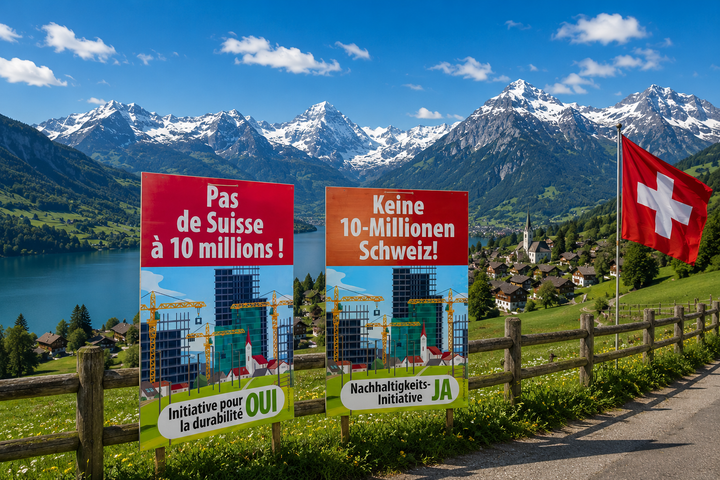
This is a special feature of Swiss politics. Swiss citizens elect politicians and also decide on concrete questions themselves, at every level of the state. Federal votes take place up to four times a year; cantonal and local questions are usually added to the same voting Sundays.
The three federal tools
Volksinitiative
Popular initiative
100,000 signatures · 18 months
Citizens propose a change to the constitution. Parliament can recommend a no – or put forward a counter-proposal («Gegenvorschlag»). To pass, it needs a majority of voters and of cantons.
Obligatorisches Referendum
Mandatory referendum
automatic · no signatures
Every change to the constitution decided by parliament – and joining certain international organisations – goes to the people automatically. Again, it needs the double majority.
Fakultatives Referendum
Optional referendum
50,000 signatures · 100 days
Against a new law passed by parliament (or eight cantons can request it). If the signatures come together, the people vote – and a simple majority of voters decides.
Cantons and municipalities vote too
Kanton
Cantonal votes
Every canton has its own initiatives and referendums – for example on taxes or schools. Many cantons also put large spending decisions to the people («Finanzreferendum»).
Gmeind
Local votes
Municipalities decide on their budget and building projects – at the municipal assembly or at the ballot box. Example: in June 2023, voters in the city of Zurich approved CHF 231 million for the new Saatlen school in Schwamendingen, with 80% yes.
Example · the people decide, parliament delivers
The 13th AHV pension
In March 2024, a popular initiative for a 13th monthly state pension was accepted by about 58% of voters and a majority of cantons – against the recommendation of the Federal Council and parliament. Both then had to implement it: the first 13th pension is paid out in December 2026. How to finance it is the next question – and that goes back to the people too.
Most initiatives fail, though – historically only around one in ten is accepted. Rejected initiatives can still push parliament to act.
How a voting Sunday works
- 1
Weeks before: the ballot papers and the «Abstimmigsbüechli» with the arguments for and against arrive by post.
- 2
Vote by post: most people fill in the ballot at home and send it back – or drop it at the municipality.
- 3
Sunday noon: the polling stations close.
- 4
Sunday afternoon: the first projections, followed by the results.
Good to know: Turnout is often around 40–50%. Nationally only Swiss citizens can vote – but some cantons and municipalities, such as Neuchâtel and Jura, let foreign residents vote locally.
Chapter 5
Elections every four years
The people elect parliament every four years – the next federal elections are in autumn 2027. The Federal Council is then elected by parliament, not by the people. Cantonal governments, on the other hand, are elected directly.
Mix your own list
In Nationalrat elections you can combine candidates from different parties («panaschiere») and write one name twice («kumuliere»).
The parties in government
SVP, SP, FDP and Die Mitte share the Federal Council. The Greens and the Green Liberals are also strong in parliament. Tip: asking someone directly how they vote is considered quite personal.
Fun fact: The «Röstigraben» – the cultural gap between German- and French-speaking Switzerland – often shows up clearly on voting maps.
Chapter 6
Where politics touches you
Swiss politics affects your daily life, whether you can vote or not. These are the topics you'll hear about most – often on a voting Sunday.
Taxes
Income tax goes to the Bund, your canton and your municipality. Each sets its own rate («Stüürfuess») – so moving a few kilometres can change your bill.
Health insurance
Compulsory for everyone and charged per person, not by income. People on lower incomes can get a cantonal subsidy («Prämieverbilligung»).
Pensions
Three pillars: AHV (state), Pensionskasse (employer) and Säule 3a (private). Reforms are regularly decided at the ballot box.
Schools
Run by the cantons and municipalities – which is why school systems differ across Switzerland.
Army & civilian service
Swiss men must serve in the army («RS»), do civilian service or pay an exemption tax. For women it's voluntary.
Neutrality & the EU
Switzerland isn't in the EU or any military alliance, but has many bilateral agreements – including free movement for EU citizens.
Becoming Swiss
Naturalisation happens in three steps: municipality, canton and Bund – usually after at least ten years here. And yes, you'll get a «Heimatort».
Want to go deeper?
Further reading
Neutral, reliable places to dig into Swiss politics – most of them in English.
Federal Chancellery
The Swiss Confederation – a brief guide
The official, illustrated guide to the political system. Updated every year.
ch.ch
Political system explained
The authorities' portal for residents – clear explanations of how votes and elections work.
Swiss Parliament
Visit the Federal Palace
Book a guided tour or find the session dates to watch a debate from the gallery.
Swissvotes
Every federal vote since 1848
A searchable database with the results and voting booklets of all national votes.
easyvote
Votes in simple language
Short, neutral explanations of upcoming votes – a great way to practise German, too.
SWI swissinfo.ch
Swiss democracy news
English-language reporting and explainers on direct democracy.
Want to learn the relevant Swiss German?
Check out our flashcards for 43 political terms – or book a course with us, culture included.



Comments ()