Why the Swiss Don't Always Say What They Mean
A Swiss person doesn't demand, they kindly suggest. If that's okay with you, of course.

If you've ever had a conversation with a Swiss German person and walked away thinking, "Wait... did they really agree with me or politely destroy my idea?", welcome to the world of Swiss communication.
It was Justin, my American partner, who said something that stopped me cold.
"Why did you just ask your landlord if he could maybe consider fixing the broken heater? It's broken. Just tell him to fix it."
I didn't have a good answer. Because in Switzerland, you don't tell people to fix things. You ask them if they might, perhaps, when it suits them, possibly consider it. And everyone understands that you mean "fix it now".
This is called the subjunctive (Konjunktiv), and it's one of three grammatical moods that exist in German along with indicative and imperative. By default, most sentences are structured in the indicative, which presents information as pure fact, or the imperative, which structures the information as a command. Meanwhile, the subjunctive expresses something as having an element of doubt or fantasy.
What the Konjunktiv sounds like in practice
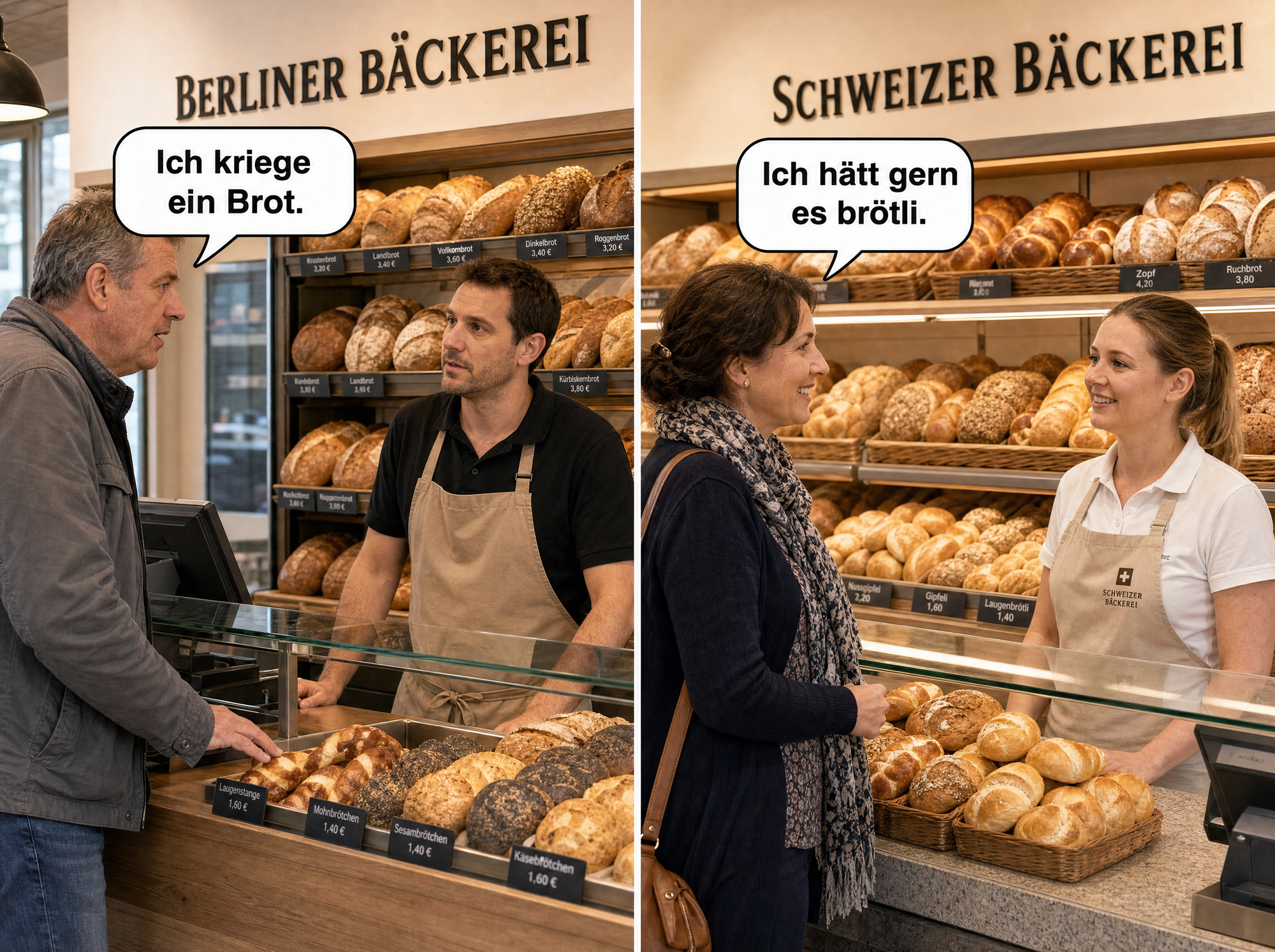
Let's start with a simple example. You want to order a bread at a local bakery.
A German might say: "Ich kriege ein Brot." – I will receive a piece of bread.
Perfectly normal in Germany. Clear, efficient, everyone knows what's happening. In Switzerland, it sounds like a military command. Avoid it at all costs.
A Swiss person says instead: "Chönt ich villicht es Brot ha?" – Could I maybe have a piece of bread?
Here's another example. Assume you need to get some documents from a colleague by the end of the day:
German version: "Ich brauche die Unterlagen bis 17 Uhr." – I need the documents by 5pm.
Swiss version: "Es wär super, wenn du mir d'Unterlage hüt chöntsch schicke, wenn's gaht?" – It would be great if you could send me the documents today if that works for you?
Same deadline. But the Swiss version gives the other person the illusion of choice. And that illusion is everything. The language site Lingolia provides a nice introduction to the grammar involved if you want a deep dive, and be sure to also check out our introduction to learning Swiss German.
We're curious: What's been the hardest part of "decoding" Switzerland for you? Take 2 minutes and tell us. Your answer shapes what we write next.
The Diminutive: The Konjunktiv's best friend
The Konjunktiv doesn't operate alone. It has a sidekick: the Diminutive. The Swiss German habit of shrinking everything into being something cute and small by adding "-li" to the end of the word.
The bread from the bakery? It's not Brot. It's es Brötli (a little bread). To discuss something serious with someone, you don't need to have a word with them. Instead, you have es Wörtli (a little word). A boat on the lake? Es Böötli (a little boat, you get the idea).
This approach makes otherwise serious situations more approachable and less intense. It helps take the edge off and prevents the other person from feeling threatened by your intentions.
Combine the Konjunktiv with the Diminutive, and you get really approachable and non-threatening sentences like: "Mir chönted villicht mal uf es Gläsli Wy zäme?" – We could perhaps have a little glass of wine sometime? Using the Konjunktiv mood and Diminutive nouns together makes the whole request feel innocent, non-confrontational, and somehow enticing all at once (even if you plan to discuss something extra serious with them during the meet-up).
Three concepts that make Switzerland talk this way
Nobody actually wants permission to do something. Nobody thinks the glass of wine is small. But we're a small country with four languages, 26 cantons, and over 2000 different and politically independent municipalities. That's many differences living in very close quarters. We could then choose either to fight constantly or to get very good at not stepping on each other's toes. Switzerland chose the second approach, and this shows through the language and behavior. Three underlying concepts are at work here:
1) Standing out is not highly valued. There’s a rule nobody says out loud in Switzerland: don’t make yourself bigger than the room. Walk in loud and self-promoting, and you don’t read as confident but rather as someone who hasn’t figured out how things work. Staying more reserved is a strategy rather than shyness. Every softened sentence is doing what linguists call face-saving: a blunt request (“send me the documents by 5 o'clock”) is a face-threatening act, but wrapped in a Konjunktiv form (“it would be great if you could send the documents by 5 o'clock…”) nobody’s autonomy gets stepped on.
2) It’s about protecting the relationship. When a Swiss person talks to you, the content of the sentence is not as important as the relationship it supports. This keeps a constant focus on the “relationship level.” Before anything gets said about the broken radiator in your apartment or feedback on your draft presentation, the conversation is first quietly asking: are we still good? That’s why hearing feedback like “that’s an interesting approach” can mean “this is completely wrong”. These words protect the relationship while the real meaning travels underneath.
3) Consensus beats conviction. The way the Swiss talk is really the country's political system shrunk to table size. All the different cultural and independent political entities coexisting in Switzerland means that no single group can impose its will on the others. So the loud, extreme position almost never wins; it instead gets sanded down into a compromise that everyone can live with. That changes the phrasing “fix my radiator now” into a Swiss-approved “could you maybe, when it suits you, take a look at my broken radiator?”
Wrap Up
Let's summarize why the Swiss don't always just bluntly say what they really mean:
- Swiss German has three grammatical moods. The one that matters most for daily life is the subjunctive (Konjunktiv). It frames requests as suggestions, giving the other person the illusion of choice. That illusion is intentional, and it's important.
- The Diminutive (-li) is the Konjunktiv's sidekick. Adding it shrinks words into something smaller and less threatening.
- Behind the language are three cultural values: don't stand out, protect the relationship, and favor consensus over confrontation. They're a system built for a small country with many differences living in close quarters.
- When a Swiss person says "that's an interesting approach", they may mean the opposite. The real message often travels underneath the words, not in them.
- None of this is dishonesty but rather a style used to preserve the relationship as much as to convey the message.


Comments ()